
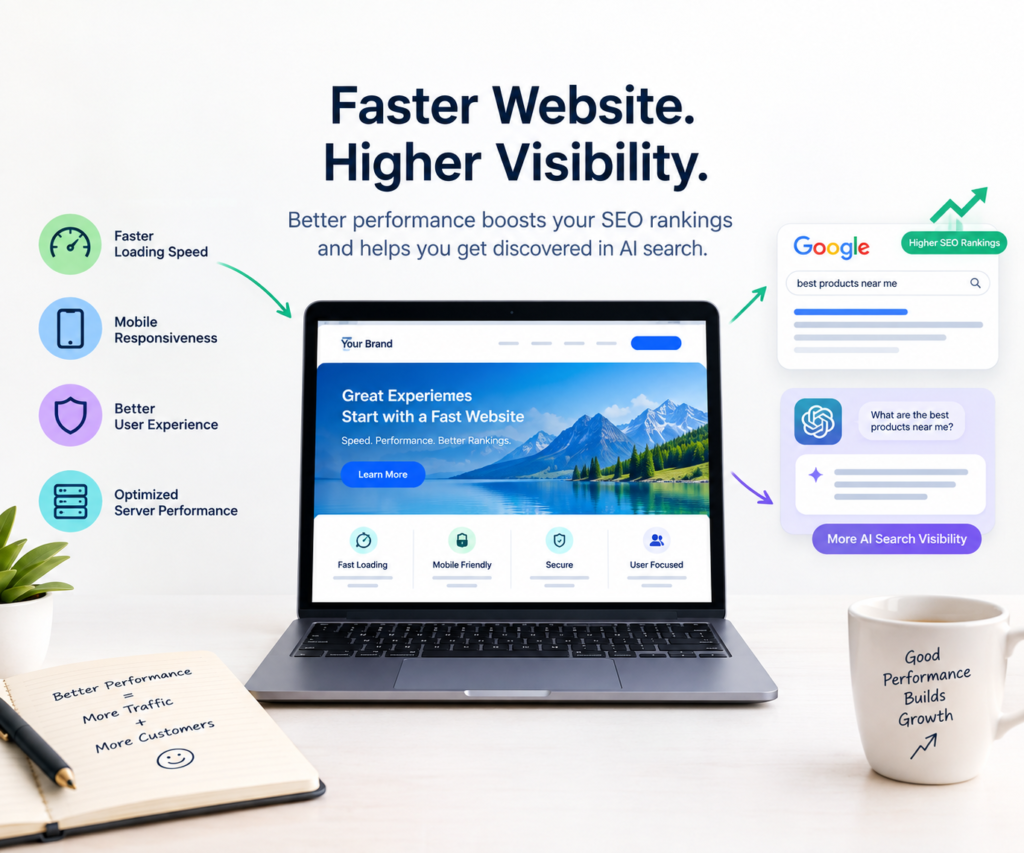
In today’s digital landscape, having a well-designed website is no longer enough. Businesses need websites that are fast, responsive, accessible, and easy to understand. Website performance has become an important part of digital marketing because it influences not only how visitors interact with a website but also how search engines and AI-powered search systems discover, interpret, and recommend its content.
As search continues to evolve beyond traditional Google results, businesses must think about visibility across both conventional search engines and AI-powered platforms. Improving website performance can therefore provide a competitive advantage in SEO and AI search optimization.
What Is Website Performance?
Website performance refers to how quickly and efficiently a website loads and responds when someone visits it. It includes factors such as page loading speed, responsiveness, mobile usability, server performance, image optimization, and overall technical efficiency.
A website that loads quickly allows users to access information without unnecessary delays. A slow website, on the other hand, can create frustration and encourage visitors to leave before engaging with the content.
Performance is particularly important on mobile devices, where users may experience slower network connections or have limited resources. A fast, mobile-friendly website can provide a significantly better experience and support stronger organic visibility.
Why Website Performance Matters for SEO
Search engines aim to provide users with useful results and a positive search experience. Website performance is therefore an important part of technical SEO.
One of the most important areas to consider is Core Web Vitals, which evaluate aspects of page experience, including loading performance, responsiveness, and visual stability. Improving these technical signals can help create a better experience for visitors while supporting a website’s overall SEO strategy.
However, website performance should not be viewed as a replacement for quality content. Search visibility depends on many factors, including relevance, content quality, authority, technical accessibility, and user experience.
The goal is to combine excellent content with a technically strong website.
Faster Websites Can Improve User Engagement
Website speed directly affects how people interact with online content. When pages load quickly, visitors are more likely to explore additional pages, read articles, complete forms, or make purchases.
A slow website can have the opposite effect. Even if a page contains excellent information, visitors may leave if they have to wait too long for it to load.
Better performance can contribute to:
- Lower abandonment rates
- Longer and more meaningful user sessions
- Better mobile experiences
- Higher engagement with content
- Improved conversion opportunities
- Stronger overall website usability
These benefits make performance optimization valuable not only for SEO but also for broader digital marketing performance.
Website Performance and AI Search
Search is changing rapidly with the growth of AI-powered platforms. Users can now ask conversational questions and receive summarized answers instead of simply browsing a list of links.
This creates a new opportunity for businesses: getting their content discovered, understood, and potentially referenced by AI-powered search experiences.
AI search optimization is sometimes described as Generative Engine Optimization (GEO) or Answer Engine Optimization (AEO). While these approaches are still evolving, one fundamental principle remains important: AI systems need to be able to access and understand website content.
A technically healthy website makes it easier for search crawlers and other automated systems to discover pages, process information, and understand the structure of a site.
Performance is therefore part of a broader technical foundation for AI visibility.
Crawlability and Accessibility Matter
A website cannot perform well in search if important content cannot be properly accessed or interpreted.
Technical issues such as broken links, poor navigation, blocked resources, incorrect redirects, slow server responses, or poorly structured pages can make it harder for search engines to crawl and understand a website.
Businesses should make sure that important pages are:
- Easily accessible through internal links
- Properly indexed
- Supported by clean website architecture
- Mobile-friendly
- Free from unnecessary technical barriers
- Clearly structured with relevant headings
- Supported by descriptive metadata and structured data where appropriate
These practices create a stronger technical foundation for both traditional search engines and emerging AI search systems.
How to Improve Website Performance
Improving website performance does not necessarily require rebuilding an entire website. Businesses can begin with several practical improvements.
1. Optimize Images
Large, unoptimized images are one of the common causes of slow page loading. Compress images and use modern formats where appropriate. Images should also be properly sized for the devices on which they will appear.
2. Improve Server Response Time
A slow server can delay the entire page-loading process. Businesses should evaluate their hosting environment, caching strategy, database performance, and content delivery setup.
3. Minimize Unnecessary Code
Excessive JavaScript, CSS, plugins, and third-party scripts can increase page complexity. Removing unnecessary resources can make pages lighter and more efficient.
4. Prioritize Mobile Performance
A website should work smoothly across smartphones and tablets. Test pages on different screen sizes and network conditions to identify performance problems that desktop testing may overlook.
5. Use Browser Caching
Caching allows certain resources to be stored temporarily so returning visitors do not need to download everything again. Proper caching can significantly improve repeat visits.
6. Strengthen Internal Linking
Internal links help users navigate a website and help search engines discover relationships between pages. A logical internal linking structure also makes important content easier to find.
7. Monitor Performance Regularly
Website performance should not be treated as a one-time project. New plugins, images, tracking tools, design changes, and content can gradually make a website slower.
Regular performance testing helps businesses identify problems before they negatively affect user experience and organic visibility.
The Connection Between Performance, SEO and Conversions
The real value of website performance goes beyond rankings.
Imagine two businesses offering similar products and publishing similarly useful content. One website loads quickly, works smoothly on mobile devices, and makes information easy to find. The other takes several seconds to load and has confusing navigation.
Even if both websites initially attract similar amounts of traffic, the faster and more user-friendly website has a better opportunity to turn visitors into customers.
This makes performance an important part of the entire digital marketing funnel—from search visibility to user experience to conversion.
Website Performance Is a Competitive Advantage
As competition for online visibility increases, businesses need to optimize every part of their digital presence. High-quality content remains essential, but content alone cannot compensate for a technically poor website.
The future of search is becoming more conversational, multimodal, and AI-driven. Businesses that want to remain visible should build websites that are not only useful to humans but also technically accessible and understandable to search systems.
Website performance should therefore be considered a strategic investment rather than simply a technical task.
Conclusion
Website performance has become an important advantage in modern SEO and the emerging AI search landscape. A fast, responsive, mobile-friendly, and technically accessible website creates a better experience for users while providing a stronger foundation for search visibility.
Businesses should focus on optimizing images, improving server performance, reducing unnecessary code, strengthening website architecture, prioritizing mobile users, and monitoring technical performance consistently.
As AI-powered search continues to change how people discover information, the businesses most prepared for the future will be those that combine high-quality content, strong technical SEO, excellent user experience, and AI-friendly website architecture.
In 2026 and beyond, website performance is not simply about making a website faster. It is about making your digital presence more accessible, discoverable, useful, and competitive across the evolving search ecosystem.